Becoming Marxist

Marxists will be the leaders of the soon-to-come global anti-capitalist revolution, which with the rise of Donald Trump, becomes all-the-more urgent [1]. Brief outlines of Marxism are here, here & here.  Marxists are powerful people who can’t be fooled by media hype & shifting political winds, due to their study of, and adherence to dialectical materialism. In short: the police, Zionism, Christianity & patriotic nationalism are all tools of the ruling class to maintain social & economic inequality. These are weird ideas [2].

Marxists aren’t born, they are made. It takes a long period (years) of intense study, reading & polemics to acquire a Marxist-level of political mastery. There are many who boldly claim the title, but like everything else, there are few who are actually deserving. The most-common trap for youngsters who want to change-the-world-for-the-better is the yoke of liberalism on the left, and the lure of anarchist terrorism on the right.

Liberalism is now dead, crushed by the millstones of history; it is currently being consumed by a revolutionary upsurge on the left & fascism on the right. Every ‘liberal’ Democratic party member, along with all their supporters became political orphans on 11/09/16.  It has been a soul-searching odyssey for some, but all have since moved into (or at least towards) one of these two remaining camps. For others, this decision was a no-brainer.

The Democratic Party still exists in name, but they no longer pretend to matter in terms of power. At this point they have little clout at any level against the Republicans, and even less inclination to use it. Fascism has assumed control, and is wasting no time in showing its fangs. Anti-immigration racism at the borders & abroad will eventually be violently turned against working-poor whites in America who made up Trump’s popular constituency. This is now open class warfare at its most rapacious, with its bottomless appetite for greed & destruction.

Before liberalism suddenly expired, there existed a ~40-year period of senility. Liberals had a difficult time remembering facts, and therefore never learned any important political lessons.  Do you see all those liberals sitting on the fence?  You can’t see them now, they’re in the past tense.

A major focus of this polemica is to unmask the irrationality of these supposed ‘intellectuals’ who dominate U.S. media & academia. This intelligentsia is in fact reactionary. That’s why Marxism is officially forbidden in political discourse.

Socialism is a powerful idea, for which the elite who meet at Davos have no answers; other than more hardship, hatred & violence. Any middle-class supporters of capitalism perpetuate this fraud with their feminist, racialist and gay hysterics– which are thoroughly philistine. This toxic mixture has politically anesthetized too many people, and paved the path for a Trump presidency.

The right-wing anarchist ‘message’ is: nothing matters, so do what you want. Instant id gratification– always. Anarchism is not a political theory, it’s a dead-end which has too many 20th century illustrations– most notably the failed adventurer Che Guevara. Che and his guerrilla army raised the aspirations of millions everywhere in the 1960’s, then became isolated and was finally hunted down in the jungle by a CIA-backed Bolivian military. His millions of supporters had vanished, as he was betrayed by an informer, and quickly executed after his capture.  According to Wikipedia, “Guevara’s known preference for confrontation rather than compromise, which had previously surfaced during his guerrilla warfare campaign in Cuba, contributed to his inability to develop successful working relationships with local rebel leaders in Bolivia, just as it had in the Congo.”  In fact, it was Guevara’s failed perspective that revealed his political bankruptcy. The fact the Western hemisphere’s third world is no better off today, and in every significant measure much worse, is living proof of these political failures.

Being Marxist means you are blacklisted politically. This extends into economy & art, where Marxism is 100% not welcome by the establishment.  The truth hasn’t been popular for a long time, and Rule #1 is: this fictional narrative must continue without question.  What passes for ‘Art’ in modern bourgeois society reflects this vulgarity.

Marxists are the first ones to be assassinated (‘liquidated’ is the bourgeois term) when wars are about to start, or end. Therefore it takes great courage and strong character to become this form of leader.  People often proclaim their admiration for revolutionaries, but only for the ones who are already dead, living ones are mostly viewed as “too dangerous.”  When Marxist revolutionaries are alive, they are always active. Marxists are ruthlessly marginalized & suppressed, until they break into popular consciousness, at which point they are immediately vilified by mass media and all the institutions behind them. This keeps their message ignored, misunderstood and hated by the public until their influence can be curtailed, and its leaders ‘liquidated.’  Terrorist acts disorient the public [3]. They are often false flag operations. To discover covert intentions, simply ask: who benefits?

Disconnecting oneself from any human thoughts or feelings makes all this possible.  This is the virtual world on the modern technocrat, draped in luxury– yet empty & lifeless inside.  Surviving with one’s brains & principles intact may be the most difficult feat in modern living, but it has now become an essential task on a global scale for species survival. Only an internationally united working class armed with Marxism can defeat fascism.  The only path which ends inequality & war, is to replace capitalism with socialism.

………….><><><><><><><><……………..

Moneyball & Organized Labor

Analyzing players & pitchers in MLB requires knowledge in many areas. A scout’s eye and natural athleticism help, but are no longer required. Any position player can be cross-sectioned as a hitter by (1) knowing if they bat R/L/S, and (2) their AVG/OBP/SLG line. Defensive is now scrutinized & measured with video analysis, computers and advanced metrics to gain a better understanding of its true value in baseball. The bottom line to old-school dinosaurs– it’s been severely underrated. Defense is an individual & team skill, and can vary widely from season-to-season. All players are in decline defensively by age 30. Generally speaking, veteran players get injured less, but take longer to recover. Health is a skill, but is also influenced by playing surface, teammates, coaching, and luck.

Pitchers are best measured by IP, ERA and WHIP, reflecting how any competent manager values pitching. Preventing injuries & blowouts are a manager’s and pitching coach’s primary responsibility at any level– including MLB. Understanding pitcher abuse as a concept (and reality) is the first step towards reducing Tommy John & shoulder surgeries. Recognizing fatigue and immediately removing that pitcher is the most-necessary correction, because once a pitcher hits the wall– he’s done.  Any pitches thrown afterwards will be maximum effort with failing mechanics [1]. Pitching through fatigue ruins more young pitchers with correct form (Mark Prior), than anything else. Skippers at all levels need to seriously improve at recognizing early signs of fatigue. This will lead to improvements in bullpen management, and end much of the up-and-down-in-the-pen nonsense, which is endemic at all levels.

Pitchers need to understand their body’s better, and be more honest with themselves and their coaches. A young athlete must find good coaches (not easy), and be willing to listen to them in order to improve. Expert advice & focused work can make all the difference for a motivated young individual. This path helps the athlete gain a better understanding of their body. Improving mechanics, conditioning, strength & flexibility all become more natural through this approach. Injury prevention science will become the next revolution in baseball metrics. The cost investment to acquire elite pitching prospects is already high and rising, while most teams are scrambling for pitching. This has created an urgency for a market that had never existed before in injury prevention & health care for pitchers. Organizations can no longer afford to have their top young pitchers go down with arm problems, wiping out a season, or even a team’s competitive window depending on the depth of investment.

Player-age and their contract status are modern baseball facts. It wasn’t always considered this way. A brief labor history of MLB payrolls starts with the reserve clause, which was a founding owner’s agreement that bound players to their teams through perpetual one-year contracts.  This was upheld by the U.S. Supreme Court in 1922, when it ruled in MLB’s favor granting it anti-trust exemption. The was no union or labor organizing, so players had little leverage under this system of indentured servitude, which remained largely unquestioned in MLB until the 1960’s. At this point, most good ballplayers were paid $20K-$50K per season, an improvement over pre-war, depression-era salaries [2].

Labor attorney Marvin Miller (1917-2012) began the MLB player’s revolution towards collectively bargained players rights in the late 1960’s. This led to MLB free agency in 1976, which has benefited every player since, but particularly the veterans.  It also paved the way for free agency in the other major sports. That victory for labor in MLB earned Miller the eternal enmity of old-guard ownership, which controls the HOF voting process.  That is why reviled owner/commissioner Bud Selig gets the nod, while Marvin Miller is left out in the cold– even in death.

Generally it takes a drafted baseball player at least 9-10 years before he becomes a free agent, if he’s fortunate enough to make it that far.  A top prospect drafted out of a premier college will need 2-3 years to navigate the Rookie leagues, A-ball (possibly at an advanced affiliate, otherwise low-A), then AA, and finally some seasoning at AAA before being MLB-ready. High school and Latin American prospects are younger, so they generally take even longer.  A first-year professional ballplayer makes just over $1,000 a month.  In AA, the monthly salary is $1700 and it goes up $100 per month for subsequent years. For AAA, the monthly salary is $2150 per month and it goes up to $2400 the second year and $2700 the third year. If a player becomes a minor-league free agent, higher salaries can be negotiated [3]. These are wages of poverty, and they are only paid through the season.  There are ~ 7,500 players in Minor League Baseball at any time, and the vast majority will never make it to the majors.

Clubs have exclusive rights to their players for the first six years of MLB service time. These are complex rule-systems, meant to keep labor costs fixed for MLB owners. Unless a rookie player was able to negotiate a ‘super-prospect’ deal when he initially signed, he makes league minimum which has now been raised to $535,000 in 2017. Second-year players get approximately double that. The following off-season begins the arbitration process for 3-4 years before the player has the right to shop his talents on the open market. Arbitration is when the team and the player exchange salary figures, and (if necessary) an arbitrator will choose the ‘fairest’ offer. Most teams negotiate a deal before this hearing. Old-school owners and their front offices tend to be the toughest negotiators in arbitration, which often embitters the player who already knows he’s underpaid. LF Barry Bonds with the Pirates was a perfect example of this mistreatment. Owners have argued throughout baseball history that  (1) they never have enough pitching, and (2) they have never made money. One of those is truth, and the other fiction– you figure it out.

In the early 1970’s (still pre-free agency), top stars like Pete Rose (Reds) & Reggie Jackson (A’s) made hundreds-of-thousands of dollars. By the end of that decade, Rose (Phillies) & Jackson (Yankees) were making millions. A MLB player’s strike in 1981 split the regular season and ended in a stalemate. Afterwards, the owners covertly resorted to collusion to break free agency. Collusion was a tacit agreement by every MLB owner, GM & team executive to NOT sign any free agents from ~1984-87. It was an owner’s agreement to not improve your team, led by old-guard ownership (mainly Jerry Reinsdorf– CWS), who hated George Steinbrenner, Ray Kroc (Padres), etc… for spending on their teams. To these ancient ‘caretakers of the game,’ baseball has always been a business first, and this was payroll. All this was finally settled in the courts (in the late 1980’s) when the MLBPA sued MLB, and won over $300M in damages to stars such as RHP Jack Morris, RF Andre Dawson & newly-minted HOF-er LF Tim Raines.

Losing legally on collusion only redoubled the resolve of the most-hardened opponents of labor. As ESPN took off with their regular coverage of MLB games, highlights on SportsCenter, expanded post-season coverage, etc…the really BIG $$ started rolling in. Owners once again couldn’t control their spending & greed, which led to the MLB labor stoppage of 1994, costing the fans a season, post-season and World Series. The owners provoked a strike with the players by threatening to unilaterally impose a hard salary cap, a condition the MLBPA would never accept. The players walked out after they had been paid the major portion of their 1994 season’s salary, while denying owners their annual post-season revenue bonanza. When everything was settled between the millionaires & billionaires in the spring of 1995, new revenue streams from regional sports networks and ultimately the Internet, would bring unprecedented sums into the game. This inflationary bubble has continued up to today, with free-agent pitchers and sluggers now commanding $20-$30M/season multi-year deals.

These blockbuster television deals have made MLB owners money at a much faster rate than every group of baseball players, outside of veteran free agents, while minor-leaguers and pre-free agency major-leaguers have their labor value suppressed.

Marxists define money as congealed human labor. The commodity ballplayers produce is the game we love, and they deserve to be paid fair value for their work. Profit is the difference between what labor is worth, and what he/she is actually paid, with the capitalist pocketing this surplus value.  MLB & the MLBPA work together (like all other corporate/union arrangements) to enrich themselves and an elite clique (veteran players), at the expense of everyone else.  This inequality is no longer sustainable with the obscene amounts of money flowing into today’s game. The level of awareness is increasing [4], and soon large-scale demands for revolutionary change in baseball will come from below.

…………………><><><><><><><><><……………….

MLB GM’s & Annual Farm-System Rankings

Keith Law’s 2017 MLB Farm System Rankings were just released at ESPN.com [1]. This is a cause for much discussion among baseball fans, as Law is a recognized prospect guru and farm systems are what sustain current success stories, while sowing future championships for others. The health of any MLB organization can be measured by (1) W/L record, (2) post-season success, (3) payroll obligations, and (4) the strength of the farm system.

The general manager (GM) is directly responsible for all of this, and the first three criteria listed above are easy enough to measure, it’s a team’s minor-league system which is trickiest to quantify. It’s necessary to do this because the minors are brimming with valuable prospects, which hold the most value in today’s (and tomorrow’s) game. The best GM’s build through their farm system, then deal from strength to fill in needs during a competitive window. They lock up organizational talent early, at a fair rate, and rarely indulge in free agency splashes. Young, cost-controlled talent is king, and pitching is always primary.

With that explained, this piece is a comparison of what the 30 MLB GM’s have done for their organizations in terms of planning & value this winter. It will take Keith Law’s farm- system rankings as generally correct, and weigh the factors mentioned above to appraise chances in 2017, and beyond. Law mentions in his preface that any of the top-three teams could be switched around, depending on scouting preferences. This means the Braves, Yankees & Padres are clearly the best farm systems, a cut above the rest.  Obviously, Opening Day rosters are still not set, meaning payroll is still in flux for most teams. Cot’s Contracts is used as the reference [2].

The 2016 farm rankings are listed in parenthesis, and any rise or drop must be understood in its total context. At what point is this team in it’s competitive cycle? Are they competing for a WS? Are they in decline? Are they rebuilding?  Sometimes a team will drop in the farm rankings for all the right reasons, such as the Cubs here: they fell from 4th to 18th, because their prospects became championship players, and other pieces were also dealt in order to win it. Teams that fall in the rankings AND have a poor W/L records (Angels, D-backs) are scouting & spending poorly. They have the worst 25-man rosters & prospects, and therefore are furthest from competing. If these teams don’t have new GM’s, then their current one should be on the hot seat.
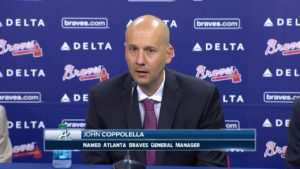
1. Atlanta Braves (1st in 2016); GM John Coppolella has amassed some nice talent from trades (Shelby Miller), and in the 2017-18 J2 draft.  But some fans still wonder why he took on RF Matt Kemp with his hefty contract and low OBP/poor defense?  Off-season pitching acquisitions include: 1/$12.5M for age-44 RHP Bartolo Colon, 1/$8M for age-42 righty knuckleball R.A. Dickey, and $12M (and 3 prospects to STL) for age-30 LHP Jaime Garcia– before he becomes a FA. They will eat innings, but aren’t likely to be very effective. Braves are wasting money all over the place, while they await fruition from their farm system. There is plenty of upside here, but also organizational flaws, which may prevent future success.

2. New York Yankees (13th in 2016); GM Brian Cashman was finally given free reign last summer, and he immediately dealt premier closer Aroldis Chapman and set-up man Andrew Miller for huge hauls. They also went in big on an earlier J2 draft, which is about to pay off in the Bronx. The Yankees signed Chapman to a 5-year deal, and the Evil Empire will be back by 2018 for sure, when A-Rod & CC Sabathia are off-the-books. They still have a propensity to waste money; Ellsbury, Headley… but now have a solid cache of prospects to compliment them.

3. San Diego Padres (20th in 2016); GM AJ Preller is currently the best GM in MLB [3]. He grabbed the top-3 selection in the Rule 5 Draft; including the back-up C and utility SS he was seeking. The rest has been pitching this winter. RHP Trevor Cahill, RHP Jhoulys Chacin ($1.75M) & LHP Clayton Richard ($1.75-2.5M) are all 1-year deals which fill 3/5 of the Padres 2017 rotation. This winter AJ Preller also acquired: age-22 RHP Miguel Diaz from MIL (top Rule 5 selection), age-24 RHP Tyrell Jenkins claimed on waivers from ATL, and age-25 RHP Zach Lee claimed on waivers from SEA; all of whom are pre-Arb, with upside. This money was spent to protect assets Luis Perdomo, Christian Friedrich, Ryan Buchter, Brad Hand, etc… and keep this franchise respectable until the waves of pitching talent start arriving from the minors by 2018. What smart teams understand is that it’s always about pitching, having enough of it and having the best of it. The Padres can’t afford to pay for the best, so they’ve done the next best thing which is acquire depth on their 40-man roster (at a bargain), through hard work & brains. Maintaining payroll & roster flexibility are also critical, which is what AJP has accomplished with the 3B Yangervis Solarte (4/$13M) & 1B Wil Myers (6/$83M) extensions. This organization will be a force to be reckoned with by 2018.

4. Pittsburgh Pirates (8th in 2016); GM Neal Huntington has built this team, but he’s now on the hot seat. The have the stud in CF Andrew McCutchen, but were shopping him (??) this winter, after winning only 78 games in 2017. McCutchen, LF Starling Marte, 3B Jung Ho Kang are a good nucleus, but they need their farm system to come through again. Pirates need to develop a closer, after trading Mark Melancon at the deadline. They also need another starter or two to support their young RHP’s Gerrit Cole & Jameson Tailon. Huntington’s FA splash was 3/$26M for age-30 RHP Ivan Nova, who represents a significant risk with limited upside for the penny-pinching Pirates. Possible fire sale in the Pirate’s future if they tank.

5. Los Angeles Dodgers (2nd in 2016); GM Andrew Friedman since leaving the cost-cutting Rays, has had the highest payroll in MLB. Cot’s Contracts currently has their 2017 payroll commitment to be $222+M, and they still don’t have a second baseman as of this writing. Their farm system is starting to slip for the right reasons, meaning prospects have developed in regulars and All-Stars. Unfortunately it’s still not enough, and this team relies too much on ace LHP Clayton Kershaw. The Dodgers basically re-signed everybody they lost to free agency, which significantly raises payroll. Friedman is putting everything on his farm system being the boost that gets them past the Cubs.  I’m skeptical.

6. Milwaukee Brewers (5th in 2016); GM David Stearns traded away franchise favorite C Jonathan Lucroy, and the players that develop from that deal (Lewis Brinson, Luis Ortiz and Ryan Cordell) will likely be his legacy, along with trading RF Ryan Braun.  Young SS Jonathan Villar is currently their best player to build around. There is no pitching for skipper Craig Counsell to manage, because these are the Brewers.

7. New York Mets (16th in 2016); RF Jay Bruce will be age-30 next season and make $13M with a batting line around .240/.300/.420 in Citi Field. Recall when the Mets withdrew prospect Brandon Nimmo on 8-1-16, and the Reds still made the deal; making it clear to everyone they were dumping Bruce’s contract. What makes Mets GM Sandy Alderson think anyone else would be interested in dealing for that?  Mets will have to eat ~$8-10M to move Jay Bruce, and they NEED to move him. This 25-man roster is thin beyond CF Yoenis Cespedes, and their brilliant young pitching which is starting to breakdown.

8. Cincinnati Reds (12th in 2016); The GM situation here is Dick Williams, with Walt Jocketty as the consiglierie. Old-school at work here, and it really hurt when they got raped by the Yankees in the Aroldis Chapman deal. What Yankees GM Brian Cashman received (above the Reds) in flipping Chapman to the Cubs proves how much dinosaurs like Jocketty are hurting their organizations. When opportunities like that are squandered, the Reds end up on the short end and are stuck with 2B Brandon Phillips & SS Zack Cosart, who are viewed as assets by their outdated brain-trust, when they are simply bad contracts to everyone else. This team can’t rebuild until it recognizes sunk costs and moves on.

9. Colorado Rockies (7th in 2016); GM Jeff Bridich signed age-31 Ian Desmond at 5/$70M (career .267/.316/.427) to play 1B. This happened less than a year after no one would give Desmond a multi-year deal at SS. The Rockies finished 2016 with a payroll of $120+M– a team record.  Around $22M went to SS Jose Reyes, who was released and is being paid another $21M by Colorado this season. RF Carlos Gonzalez at $20.4M is an albatross that the Rockies front-office (and their fans) too-much view as a bargain. There’s even been talk of extending him, meaning they must have some really nice bud in the Mile High city. Every dollar this organization spends on bats is a complete waste for the Rockies, who desperately need to acquire & develop pitching. This has been a leitmotif of their existence.

10. Chicago White Sox (22nd in 2016); GM Rick Hahn did what he had to do and dealt ace LHP Chris Sale to the Red Sox for a bounty of top prospects. This and the Adam Eaton deal to Washington are what elevates this farm system and gives their fans some hope for the future. There’s still a lot of work left here, including dealing young lefty Jose Quintana, 1B Jose Abreau, and RHP James Shields– which will require eating contract. That was a really bad trade, giving up 3B prospect Fernando Tatis, Jr to the Padres for a broken-down veteran starter, and it will delay their rebuilding significantly.

11. Minnesota Twins (3rd in 2016); New GM Thad Levine takes over after Terry Ryan was finally fired. Levine inherits one of the worst organizations in MLB as far as ownership commitment and overall talent in the majors & minors. This organization has a reputation for holding their prospects back, and developing pitchers that ‘pitch to contact’ instead of missing bats. Their pitching stinks and age-29 2B Brian Dozier is their best player, with age-23 DH Miguel Sano their sole wild-card. Manager Paul Molitor has a few more 100-loss seasons ahead of him (if he stays), until new management can draft and figure out a new direction. New ownership would help a lot.

12. Houston Astros (17th in 2016); GM Jeff Luhnow & manager AJ Hinch work well together, and are a model for new-school thinking. In today’s game, teams need their dugout manager to listen to the front office, who are supplying the talent. That means managers must understand sabermetrics, as all front offices use this in their decision-making. Payroll matters, and value means production/dollar. Astros 2017 payroll is currently at $104+M, which means they have the flexibility to get what they need at the deadline, and the prospects to make the deal. This is a young exciting team, and Carlos Beltran at DH is a significant upgrade.

13. St. Louis Cardinals (19th in 2016); GM John Mozeliak & manager Mike Matheny are another nice tandem. Unfortunately this team has gotten old, and now their second HOF-er (first Albert Pujols, then Matt Holliday) has left.  C Yadier Molina & 3B Matt Carpenter are still studs, and there’s some young talent to fill in, but no impact players on the foreseeable horizon. Their rotation is still above-average, with depth; but lacks a true ace. Cardinals won 86 games in 2016, but fell short of the post-season. I see one or two more championship runs with this core, but they’ll need some major luck to succeed. They’re capable, and (like the Giants) are always dangerous.

14. Philadelphia Phillies (6th in 2016); GM Matt Klentak saw their system graduate prospects to the big club in 2016, accounting for the drop in their farm rankings. Unfortunately they only won 71 games, so they still need a lot more help and have predictably gone the Andy MacPhail splash route this off-season in acquiring RHP Clay Bucholtz ($12M + prospects), righty set-up man Joaquin Benoit ($7.5M), OF Michael Saunders ($9M) and 2B Howie Kendrick (2/$22M). That gets the Phillies to ~75 wins in 2017, now what?

15. Texas Rangers (9th in 2016); GM Jon Daniels keeps plunging, dealing prospects for the missing link that will win them a WS. Last year it was C Jonathan Lucroy, which was a fantastic deal. This winter it’s ex-Padres RHP’s Andrew Cashner ($10M) and Tyson Ross ($6M), which forebodes disaster. The Rangers have another year or two, before their competitive window collapses from too much payroll and not enough young talent. It’s clear now that much of the scouting & organizational brains left Texas when AJ Preller went to San Diego.

16. Boston Red Sox (10th in 2016); GM Dave Dombrowski (and Orioles GM Dan Duquette) built the Montreal Expos dynasty in the late 1980’s and early 1990’s, and the 1994 Expos stand as MLB’s greatest forgotten team [4]. Dombrowski built winners in Florida, Detroit and has now been on the job for over a year in Boston. The early returns in beantown aren’t good, as the Sox were swept in the Divisional round by Cleveland last fall, and HoF DH David Ortiz has retired. Young talent will need to step in and sustain this machine, but Dombrowski has traded much of it away. Craig Kimbrel, Drew Pomeranz & Chris Sale are valuable commodities; but Manny Margot, Anderson Espinoza and Yoan Mocanda are all blue-chip prospects in whom the Red Sox had invested tens-of-millions of dollars. This talent will now yield surplus value for the Padres & White Sox instead. If the Red Sox don’t win a WS with the players Dombrowski has acquired, then these trades are busts. That’s how high the stakes are in Boston. Note: the Red Sox were given the chance to reverse the Drew Pomeranz-for-Anderson Espinoza deal with the Padres, due to “undisclosed anti-inflammatories.” The Red Sox declined [5].

17. Cleveland Indians (11th in 2016); GM Mike Chernoff & manager Terry Francona are another winning combination. The LHP Andrew Miller deal was a difference-maker for Cleveland last fall. Recall the Indians almost had Jonathan Lucroy also, who used his no-trade clause to nix the deal. He was then traded to Texas the next day. Young talent in the rotation, bullpen, and on the field make Cleveland a sustainable success story. Their current $111+M 2017 payroll gives them some flexibility, which they’ll need to make another run.

18. Chicago Cubs (4th in 2016); GM Jed Hoyer got busy early this off-season nabbing CF Jon Jay at a bargain (1/$8M), and the arms he needed– including closer Wade Davis from KCR for young OF Jorge Soler. When management drafts & develops talent, it can sustain itself on a budget. The Cubs are a textbook example of this, making them WS favs again in 2017.

19. Tampa Bay Rays (14th in 2016); GM Matt Silverman has overseen the gutting of a once-competitive franchise. Wil Myers and Matt Moore have been dealt with little to show in return. LHP Drew Smyly (the centerpiece of the David Price deal) was just flipped; and coveted starters Chris Archer, Jake Odorizzi, and Alex Cobb are next. GM’s around MLB are salivating at the thought of stealing one of these valuable arms from this directionless franchise. This organization needs new ownership as much as any MLB franchise.

20. San Francisco Giants (21st in 2016); GM Brian Sabean acquired LHP Matt Moore from the Rays for busted 3B-prospect Matt Duffy and some other junk. The Giants already had aces in Madison Bumgarner & Johnny Cueto, and have now added Mark Melancon to close. This is a championship roster for several more seasons, barring major injuries.

21. Toronto Blue Jays (25th in 2016); GM Ross Atkins is in a tight spot, with a payroll-heavy roster constructed under a previous regime, that probably isn’t good enough to win it. RF Jose Bautista was a tough negotiation for both sides this off-season, as his early 2016 negotiating stance about “knowing his value” definitely soured his market. He’s age-36, and his AVG, SLG and defense have slipped significantly, while becoming injury-prone. In the end the Jays need Joey Bats, and vise versa, so 1/$18M is about right. This winter revealed the Blue Jays have reached their payroll limit. Combine that with a lack of prospects, and I see the AL East in 2017 as Boston & NYY, with Toronto & Baltimore slipping back.

22. Washington Nationals (15th in 2016); GM Mike Rizzo hired Dusty Baker to manage, after Bud Black declined a low-ball contract offer last off-season. The Nationals are currently at $144+M according to Cots Contracts. They made deals this winter with the Padres (C Derek Norris) and White Sox (CF Adam Eaton) to shore up their roster, by dealing prospects. Young phenom Trea Turner moves from part-time CF to full-time SS, as the Nats make another run at a WS. This team may have the most talent in MLB, yet still hasn’t won a play-off series. Someday someone in Washington may point their finger at a manager who doesn’t know how to construct a line-up, or manage a pitching staff.

23. Oakland Athletics (18th in 2016); Moneyball GM Billy Beane (now kicked upstairs) deserves the HOF, but with that said, he had fallen hopelessly behind in his profession. The truth is GM Beane never recovered from the 3B Eric Chavez extension: 6/$66M (2005-10), which blew up with a bad back and financially crippled the franchise. David Forst has taken over as new GM, and he currently has a roster with a payroll at $66+M, which is mostly comprised of fungible position players & fragile arms. This is another team that needs new ownership to have any chance at competing.

24. Detroit Tigers (26th in 2016); GM Al Avila has continued the Dave Dombrowski playbook in Detroit, with predictable results. The LF Justin Upton (6/$132M) splash last winter was predictably a bust, and now it’s time to face the music. Their competitive window is closing, and there’s only one or two more runs before it’s time to rebuild. There are assets here, but also a lot of contracts that will need to be eaten when this happens.

25. Baltimore Orioles (27th in 2016); GM Dan Duquette takes his orders from owner Peter Angelos. That’s how things work in Baltimore. Last off-season it was all about signing 1B Chris Davis for 7/$161M, and giving up a 1st-round draft pick to sign RHP Yovani Gallardo. That didn’t work, so this winter Duquette dealt Gallardo ($13M) to the Mariners for veteran RF Seth Smith ($7M) as a form of salary dump, then re-signed RF/DH Mark Trumbo (3/$37M). This team desperately needs starting pitching, and yet has done nothing this off-season to acquire any. There’s obviously nothing coming from the minors, as evidenced by this farm-system ranking, so no one knows what they are doing to fill their most basic need? Spring Training is less than a month away.

26. Kansas City Royals (23rd in 2016); GM Dayton Moore extended breakout starter age-28 LHP Danny Duffy at 5/$65M which is a win-win deal. I always like GM’s who make those deals, as they lock down talent and build team chemistry, without busting an organization’s budget. I’m just not sold that it will work here. This team could win it all again, or it could bust again. The smart GM has to play for the former, while making contingencies for the latter. After winning the WS in 2015, this franchise is now at a crossroads. Update: Within hours of this publication came the news of age-25 RHP Yordano Ventura dying in a car crash in his homeland of the Dominican Republic. MLB and all fans mourn his passing.

27. Los Angeles Angels (30th in 2016); GM Billy Eppler & manager Mike Scioscia are in no-man’s land, with huge payroll bloat around the best player in the game, CF Mike Trout. They have no effective pitching, starting or bullpen. With ~$150M already committed in 2017, for a second-division team with no prospects, this may be the worst organization in MLB.

28. Seattle Mariners (28th in 2016); GM Jerry Dipoto has made the biggest overall splash this winter, and is the current fashionable GM. His dealings look more like reshuffling chairs on the decks of the Titanic, than actual improvement, as the 2017 Mariners look suspiciously like the 2016 Diamondbacks or 2015 Padres to this observer. There’s not enough pitching to compete with Texas or Houston, much less for a WS. This looks like one last gamble with a veteran core that has never come close to putting it together. Whatever the result, the Mariners are a story in 2017.

29. Miami Marlins (29th in 2016); GM Mike Hill has been criticized for his recent deal-making, and the RHP Dan Straily trade is his latest head-scratcher. Hill already inked RHP Edinson Volquez to a 2/$22M deal earlier this winter, which seemed like an overpay. The Marlins needed another arm, so #2 organizational prospect RHP Luis Castillo (the trade-back in the Colin Rea fiasco with the Padres last July/August) was shipped with 2 others to Cincinnati.  Castillo throws ~ 100 MPH and has a closer profile, but is a long ways away. All that is probably more valuable than a 5th starter whom the Reds picked up on waivers last April. In addition, the Marlins have multiple back-loaded contracts (such as Giancarlo Stanton’s), which are about to balloon. If things go south in 2017, the Marlins are going to have another fire sale, and there’s a significant chance they will. The Marlins can’t possibly replace heart-and-soul inspiration, and ace RHP Jose Fernandez– RIP.

30. Arizona Diamondbacks (24th in 2016); New GM Mike Hazen is a Dombrowski protoge, and he replaces Dave Stewart, which is a relief to D-back fans. Age-33 RHP Zack Greinke (5/$172.5M remaining) may be the biggest current albatross contract in MLB, and the Shelby Miller deal with the Braves last winter was a complete disaster, which is why this farm system is ranked dead last. It’s going to be a long rebuild in Arizona with Grienke, RHP Taijuan Walker, 1B Paul Goldschmidt, and CF AJ Pollock as their only real assets.

……………..><><><><><><><………..

Skin

Our skin speaks as to who we are. Much discussion occurs over skin pigmentation and what it’s supposed to mean, while very few understand what skin actually is. Scientifically speaking, skin is an organ– like the heart, liver and kidneys. Skin is the main part of the integumentary system, which regulates our temperature, while resisting heat, cold & moisture, so other organs & their systems can function.

skin anatomy

Skin is also our first impression, and anyone interested in beauty understands the value of its care. It doesn’t matter whether the ancestry is European, Asian, African, Native American or Aborigine; without proper skin management, the sun and other elements will damage and wear it out, making it’s owner look older. They key for beautiful & youthful skin is to retain the body’s essential oils, while removing as much dirt, grime & other toxins as possible.

The face is most vulnerable, as the skin there is more oily and most-exposed to harmful UV-rays. Sunblock before outdoor sports and a broad-rimmed hat for strolls are essential. Women’s soccer star Mia Hamm (pictured below) has now revealed she has significant retinal damage from years of intense outdoor-light exposure. Sunglasses are now an essential eye-health tool.

Mia Hamm 1999 World Cup

Our skin is actually more than just us, it contains a microbiome of mites, bacteria, viruses, and other organic matter as it’s outer-most layer. The germaphobic response to this science (like everything else) was to create hysteria about it, then attack it. This has led to a rash of diseases, which are the result of the skin being dried out and stripped of its natural, protective microbiome layer. Many of these psoriasis, eczema, itchy/allergic skin conditions occur because of too much air conditioning & showering; especially in climates like Florida where the outdoor heat is extreme, and people haven’t properly adjusted themselves.

Climatizing yourself was discussed briefly in an earlier piece [1]. It is critical for good health, wherever you are, to climatize yourself to the outdoor temperature. Obviously, stay indoors when temperatures get too extreme, which is below 0 and above 100 degrees Fahrenheit; but with that said there is no way for skin (or any other bodily organ) to function properly, if it’s a shock for the body to step outside. This is now a common mistake, as many Americans are addicted to this lifestyle, and it’s a huge part of the current obesity epidemic.

By constantly and artificially moderating the indoor living temperature, an individual has no true sense of the outdoor environment. If you see someone dressed too warmly in public, you can bet they are addicted to heat-A/C. They typically are in poor health and have a weight/mobility problem, which is often self-inflicted through neglect.  As excessive fat is retained, the oils & odors emanating from the skin become unpleasant, to put it nicely. To be real, it’s a sick joke on ignorant people, by greedy elitists. Note that this is now a problem affecting ALL generations of modern affluence, while much of the world is still starving.

Bad Soap

Antibiotic resistance is another issue that starts to come into play with the excessive use of anti-microbial soaps. Pretty soon this unnatural selection leads to super-bugs we can’t control. Medicine and genetic engineering have their limits, and humans aren’t even close to understanding what & where they are. Any introduction of new products whether it’s GMO’s or new drugs & consumer goods, need to be weighed scientifically in all spheres; and that remains impossible under capitalism.

Being OCD about touching one’s face, picking at scabs, chewing fingernails, etc… is poor personal hygiene practice.  Piercing & tattooing are by medical definition self-mutilation; obviously this is a personal choice that can be justified as self-expression, but note that it often comes across as a clichéd cry for attention. Know that line beforehand.

Exhibitionism

While we’re on skin, we must discuss hair which is simply an extension of our skin. Covering it from sun damage, and minimizing washings to prevent essential oils from being stripped away are the same themes.  Becoming your own barber/stylist will also help your hair look better all the time.  Scissor, clippers and a mirror with adequate light are all that is needed.

Tea Tree Shampoo

Skin and hair-care products should be plant-based. Petroleum-based products are toxic, so use organic for your skin & hair. Personally– I prefer cocoa butter for skin, and tea tree for shampoo. I shampoo once/week on average. Mostly I just rinse my hair in the shower, and use cocoa butter as conditioner.

On non-shower days (days I’m not working, nor very physically active), I use a soapy wash-cloth & sink. This allows me to hit the necessary spots: faces & hair, armpits, etc… with minimal time, energy, and water use. I live in Florida, where it’s summer from mid-January to mid-November– with global warming now.  I spend much of this time indoors at home without a shirt on for clean cooling, as wearing too much clothing leads to excessive sweating & grime build-up. I use a towel between my skin and any furniture, and rarely use the A/C when home alone.

Cocoa Butter

Any situation in which you are overheated and need rapid core cooling, COLD showers are a great skin management tool. Heat stroke is defined as the shut-down of the skin organ system. Perspiration, which is the body’s cooling mechanism, has ceased and the core temperature is beginning to rise. This can lead to coma and brain damage, if not reversed in time.

A more routine skin management tool is the dry rub, which means working the grime & excess skin off with a soft towel. This can and should be done throughout the day, as skin & hair begin to feel itchy and uncomfortable.

Speaking of uncomfortable, avoid the weave. I don’t know who precisely came up with this awful idea, but it needs to end. It’s 1) completely unnatural, 2) doesn’t work outdoors or when wet, 3) can’t be touched–  just decoration, 4) costs a fortune to maintain, 5) leads to further scalp erosion and hairline loss due to the tension, and 6) MEN PREFER REAL HAIR.

Bad Weave

Don’t be ‘relaxing’ it either, all those harsh chemicals kill those delicate hair follicles- making you bald, girlfriend.  Go with the ‘fro; and if you can’t braid it– fade it.

Anti-perspirant/deodorant is a necessary evil in modern Western culture, as you just can’t afford to stink in public or around friends. Anti-perspirants prevent sweating; deodorants neutralize odor-causing bacteria. More-effective deodorants, means stronger chemicals. Antiperspirants are based on ingredients such as aluminum chloride, aluminum chlorohydrate and aluminum zirconium trichlorohydrate. These aluminum salts (which have been established as a neurotoxins), form a temporary blockage in the sweat ducts– stopping the flow of sweat to the skin’s surface.  Apply judiciously, knowing it’s a low-level toxicity, is my only advice.

Obviously there are huge & powerful interests (cosmetics, fashion/modeling, etc…) which don’t want people to live & think the way I’ve described. Enacting what I have outlined above on a mass scale would end those industries as we know them, and it would be a giant step forward for humanity. The amount of toxic waste these industries produce is not doing our planet or species any good. One of the biggest issues we as homo sapiens are facing is the inability to look at our own skin, and the skins of others, honestly.

……><><><><><><><><><……..

Timeline of DNC Email Leaks

Disclosures of dirty official secrets & war crimes have repeatedly rocked the established order since WikiLeaks emerged in 2010. This video currently has over 15 million views:

Julian Assange is the founder & brains behind Wikileaks, a whistle-blowing online organization which publishes classified state secrets for the world to read & discover. Assange has currently been held-up in the Ecuadoran embassy in London for four years, due to trumped-up (politically motivated) rape charges– which are being pressed by Swedish authorities at U.S. government behest. With whistle-blowers Edward Snowden in exile in Russia and Bradley (Chelsea) Manning locked away in a U.S. military prison, Assange too is a political prisoner. This serves as a chilling reminder of the cost one may have to pay for opposing elite interests.

julian_assange_2014

July 10, 2016: Seth Rich a 27-year-old staffer for the Democratic National Committee (DNC) was shot twice twice in the back of the head on his way home in Washington, D.C. around 4 a.m. He died later in the hospital and the circumstances remain murky, as D.C. police insist the murder was the result of a botched armed robbery– but have no leads. Rich’s wallet, cell phone & watch were still with him when his body was found. Seth Rich was in charge of DNC voter expansion data and had access to a wide range of information about the inner workings of the Democratic party.

seth-rich

The content of these emails remains mostly undiscussed in official media, as the emails were from Hillary Clinton’s campaign chairman John Podesta. The major revelations (among the many) were that the DNC was illegally funnelling money away from Bernie Sanders and towards Hillary Clinton, in order to help her gain the Democratic nomination. Any mention of this email content today is tantamount to treason, and implies being an “agent of Putin” by the media, but back then this was still an issue Hillary Clinton and the Democrats were trying to contain.

debbie-wasserman-schultz-vp-biden

July 24, 2016: Democratic National Committee chairwoman Debbie Wasserman Schultz (pictured above w/ VP Joe Biden) resigned, as she was heavily implicated in the email scandal which revealed her improprieties in favor of Clinton.

August 9, 2016: WikiLeaks announces a $20,000 reward for information leading to the killer of Seth Rich. A few days later Julian Assange gave this extraordinary interview with Dutch television station Nieuwsurr via Skype, in which he openly questioned the official narrative: [1]

Assange: Whistle-blowers go to significant efforts to get us material and often significant risks. There was a 27-year old that works for the DNC who was shot in the back … murdered … for unknown reasons as he was walking down the street in Washington.

Host: That was just a robbery wasn’t it?

Assange: No. There’s no finding.

Host: What are you suggesting?

Assange: I am suggesting that our sources take risks and they become concerned to see things occurring like that.

Host: But was he one of your sources, then?

Assange: We don’t comment on who our sources are.

Host: But why make the suggestion?

Assange: Because we have to understand how high the stakes are in the United States and that our sources face serious risks … that’s why they come to us so we can protect their anonymity.

July 2016: Begins a sharp escalation of the anti-Russian (pro-war) campaign, that was (and still is) supported in bourgeois circles. Under the academic influence of structuralism, positivism and postmodernism; the NY Times, Washington Post, the Nation, Newsweek & Time now churn out their virulent pseudo-left red-baiting, in all its irrationalist & idealist forms– on an unprecedented scale.  Gays, feminists, dissidents, ex-radicals and other ‘nonconformists’ who complain about everything (yet can’t be bothered with facts) populate their rank-and-file, and the purpose of this campaign is to keep this ‘middle class’ layer as self-satisfied & politically inactive as possible.  As evidence to its effectiveness, the left-wing 2016 post-election protests quickly met a cold & lonely death. [2]

October 7, 2016:  WikiLeaks publishes thousands of emails retrieved from John Podesta’s private Gmail account.  Reading Podesta discuss Hillary’s “public” and “private” political positions, as well as her grovelling to the financial aristocracy of Goldman Sachs, only reinforced the popular notion that she’s a fraud.

As a final footnote on ‘Russian hacking,’ evidentially John Podesta’s password was ‘password,’ and he gave it out freely to other staffers.  Julian Assange is now famously quoted as saying, “A 14-year-old kid could have hacked Podesta.” [3]

These are the incompetent and sociopathic zombies who make up Washington’s elite. It’s impossible for the ruling class to frame any of this logically, so we the people are again subjected to a propaganda blitz where official lies, hysterical red-baiting, and implausible denials never end.

October 25, 2016: Huge Obamacare premium increases announced for 2017. This, more than anything else, cost Hillary Clinton and the Democrats on Election Day.

October 28, 2016: A letter from FBI Director James Comey to Congress announcing new “investigative steps” in the probe of Democratic presidential candidate Hillary Clinton, exposes raging conflicts within the national security apparatus. It still rages on, with no public input.

fbi_james-comey

November 8-9, 2016: After being written off and given no chance by nearly every political expert, Donald Trump wins the Electoral College and the US presidency, despite losing the popular count by ~2.8 million votes. President Barack Obama immediately declares everything over, as the entire 18-month election process (a completely degraded spectacle) was just “an intramural scrimmage.”  Mass media and the entire political intelligentsia immediately shift to the right, going into overdrive on the ‘Russian hacking’ narrative as the reason for Donald Trump’s victory.

intramural-scrimmage

January 6, 2017: The 50-page US intelligence report (purported to contain ‘bombshells’) provides no evidence that Russia was responsible for hacking into the email of the Democratic National Committee and Clinton campaign chairman John Podesta.  The report consists of unsupported conclusions by the CIA, FBI and NSA, using the phrase “we assess” 19 times, without a single fact to demonstrate Russian involvement. [4]

4th-international-literature

This is capitalism 2017, and its masters have evil designs on humanity’s future. These fascist philistines only care about themselves, so if working & young people want better, they are going to have to unite among themselves and fight for it. As Trotsky once pointed out, “No devil has ever cut off his own claws.”  We the workers & youth must unite internationally across all industries under the banner of revolutionary socialism to win true freedom, peace & equality.

………..><><><><><><><><><>><…………..

Women Who Rock

I’m not strict when it comes to genres. You can rock any form, including classical music.  There are plenty of women playing & conducting Mozart, the greatest rock-star ever.  These are the women I (mostly) respect in the various popular music forms which have evolved from the 1920’s (birth of audio recording), up through the year 2000 or so. This review hits the highlights, and is by no means exhaustive.

Bessie Smith (1894 – 1937) was the most popular female blues singer of the 1920s & 1930s, and a major influence on jazz singers:

bessie_smith-empress_of_the_blues

The Carter Family were traditional folk music, the first vocal group to become country music stars. They originally recorded from 1927 to 1956, and still exert a profound impact on bluegrass, country, gospel, pop & rock:

carter-family

Mahalia Jackson (1911 – 1972) was the ‘Queen of Gospel.’  She explained, “I sing God’s music because it makes me feel free. It gives me hope. With the blues, when you finish, you still have the blues.”

mahalia-jackson

Ella Fitzgerald (1917 – 1996) is still the ‘First Lady of Song’ & the ‘Queen of Jazz.’  No one sings the Gershwins’ or Cole Porter’s songbooks better:

ella-fitzgerald

Billie Holiday (1915 – 1959) had a profound influence on jazz music, as no one sang with more feeling:

Patsy Cline (1932 – 1963) was country music’s biggest star. Her hits began in 1957, and continued until her tragic death. She was killed in a multiple-fatality crash of the private plane of her manager, under murky circumstances:

patsy-cline_walking-after-midnight

Shirley Scott (1934 – 2002) was a hard bop & soul-jazz organist.  Known as ‘Queen of the Organ.’

shirley-scott

Early-’60s New York girl groups totally rock:

chiffons-1963

So do mid-’60s New York girl groups:

shangri-las

As did the Phil Spector girl groups:

spector-the-ronettes

Joan Baez was the original female folk-rock artist:

joan-baez-bob-dylan

The folk genre eventually became ‘singer/songwriter’ with artists like Joni Mitchell:

joni-mitchell

Nina Simone (1933 – 2003) was a true artist. She was a first-rate singer, songwriter, pianist & arranger who was able to work with (and earn the respect of) elite jazz artists such as Miles Davis. Simone was a civil rights activist when it mattered, and could work in virtually any musical style from R&B to classical:

nina-simone

Motown was the hit machine record label of the mid-late 1960’s, and the Supremes were label owner Berry Gordy’s top act:

supremes3

Martha Reeves and the Vandellas recorded some of the most gritty & danceable R&B of the Motown hit-making era:

marthav_motown

Tammi Terrell (1945-1970) & Marvin Gaye (1939-1984) is my selection for top duet couple. Terrell was diagnosed with a brain tumor in 1967, and had eight surgeries before succumbing to her illness at age 24:

tammi-terrell-marvin-gaye

Maureen Tucker was the drummer for the Velvet Underground.  Nico was the original bad girl, who became an artist no one understood.  This is where they fit in chronologically, but really they’re ~20 years ahead of their time:

andy-maureen-lou

nico7

Shocking Blue was a late 1960’s Dutch psychedelic rock band, which has famously been covered by Bananarama & Nirvana:

shocking-blue

Grace Slick and Jefferson Airplane were okay, I guess:

Janis Joplin (1943 – 1970) was a raw & uninhibited blues singer. Excess led to her accidental drug overdose, after only four albums including the posthumous Pearl (1970):

janis

In 1968, singer/songwriter/dancer Gal Costa became a part of the Tropicalismo movement, which was a Brazilian artistic movement whose anti-authoritarian & revolutionary expressions made them a target of censorship & repression by the military junta that ruled Brazil from 1964-1985:

gal-costa

Cuban singer Celia Cruz (1925 – 2003) was the ‘Queen of Salsa’, the most popular Latin artist of the 20th century:

celia-cruz

Googoosh is an Iranian singer/actress of Azerbaijani origin, and the most iconic pop diva in the Middle East. She is famously known for remaining in Tehran following the Iranian Revolution in 1979, and not performing again until 2000 due to the ban on female singers:

googoosh_iranian-diva

Country music traditionally paired its upcoming female stars with moldy oldie males, in order to give them the boost they often needed.  Dolly Parton was no exception:

porter-dolly

Aretha Franklin is the Queen of R&B/Gospel, with the perfect blend of attitude and vocal power:

lady-soul

Tina Turner’s version of CCR’s “Proud Mary” is possibly the most-covered karaoke song in pop-cultural history:

tina-turner

As for Hollywood, Bob Fosse’s Cabaret (1972) is the likely greatest musical ever filmed, and Liza Minnelli as Sally Bowles was a performance of a lifetime:

cabaret-1972

Same with the unstoppable & incomparable Barbra Streisand in Peter Bogdanovich’s What’s Up, Doc? (1972):

babs

Bette Midler was a Broadway performer who made her film debut in 1979 with The Rose, a hard-hitting fictionalized account of the life & death of Janis Joplin– one of the most stunning debut performances in Hollywood history:

bette-midler-1979

It’s a mystery why so many people hate on Yoko Ono, she was good enough for John Lennon (1940-1980), who always considered her an artist:

john-lennon-yoko-ono-1971

Jessi Colter was one of the few female country artists to emerge from the mid-1970s “outlaw” movement, which also featured Waylon Jennings whom she married:

jessi-waylon

The Swedish act ABBA helped bring disco to America, for better or worse:

abba_gold-records

Disco (1974-80) began as a street vibe, with DJ’s as artists & genre leaders. Disco was influenced by soul, funk, glam, reggae/dub & punk. It spawned new-wave, rap & electronica:

disco-box_4cds

Disco was a genre dominated by women, and Donna Summer & Gloria Gaynor became its greatest artists:

queen-of-disco

Disco was an explosion of minority street culture, gay pride, and feminism.  Acts like Sister Sledge, Chic & a host of one-hit wonders including: Shirley (& Company), Vicki Sue Robinson, Rose Royce, Lipps Inc, Anita Ward, (and too many others to list here) made some of the most enduring dance music ever created.

gloria-gaynor

These and other cultural institutions birthed in the 1970’s, were controlled by corporate machinery through record labels & radio monopolization.  This revolution in popular culture was quickly over-saturated and shamelessly exploited until its impact finally subsided.  By 1980, disco was history and newly-arrived MTV was channelling kids into new wave (Eurythmics, pictured below) and pop metal:

eurythmics

For some, punk is what really rocks and Patti Smith was the original poet:

patti-smith_-horses-1975

One of the greatest forgotten punk singers is Poly Styrene (Marion Elliot) of X-Ray Spex, accompanied by saxophonist Lora Logic (Susan Whitby):

xray-spex

The Raincoats were formed in 1977 by UK art students Gina Birch and Ane de Silva, inspired by the “anyone can do it” spirit of punk:

raincoats

Blondie was Debbie Harry (singer/songwriter), with good help from (guitarist/songwriter/lover) Chris Stein– when he behaved himself. Blondie began as NYC punk, and quickly became the biggest crossover artists of their era. “Heart of Glass” is punk/disco crossover; “Rapture” is THE original rap crossover; and “The Tide is High” is rock/reggae crossover:

blondie

Anyone who ever tried to start a band knows that good bass players are hard to find.  Punk/alternative has a long tradition of women on bass, starting with Tina Weymouth (Talking Heads):

tina-weymouth-talking-heads

Exene Cervenka was a lead singer for X, the legendary Los Angeles-based punk band:

exene-cervenka-in-x

The Slits (formed in 1976) in the words of band leader Ari Up:
“We felt naturally feminist without saying so. At the time you were expected to comb your hair perfectly neat and be glamorous, like the magazines tell you to be. You couldn’t be naturally sexy. I felt we were very sexy by nature. If we wanted to be sexy we were, but not to please men. We just did our own thing. In this way, we threatened society. The witch hunt was on. I was stabbed in the street, just for looking the way I did, by a guy who looked like John Travolta.”

slits_cut-1979

Post-punk feminism exploded with Pat Benatar, Chrissie Hynde (Pretenders), B-52’s, Siouxsie and the Banshees, Joan Jett, the Go-Go’s, Cyndi Lauper, etc…

pretenders-1980

b-52s

pat_benatar

the-go-gos

The biggest MTV star, and icon of the 1980’s (and into the 1990’s) would be Madonna, who today is the indisputable ‘Queen of Pop’:

madonna

Cuban emigrant Gloria Estefan became the 1980’s biggest Latin crossover artist, sparking a global interest in Spanish dance rhythms & beats:

gloria-estefan

Country singer/songwriter Reba McEntire became the genre’s biggest female star, and eventually crossed over into Hollywood television:

reba-mcentire

Pop music always rules the charts & drives the industry. Janet Jackson, Whitney Houston and Mariah Carey became the next generation of divas that followed in the wake of Madonna:

janet-jackson

mariah

Female bassists in alternative rock included Kim Gordon (Sonic Youth, pictured below), Kim Deal (Pixies), and D’arcy Wretzky (Smashing Pumpkins):

kim-gordon_sonic-youth

The Carpenters had a pop sound all their own in the 1970’s, up until Karen’s death due to anorexia in 1983, and (believe it or not) she is still cited by alternative artists as an influence:

karencarpenter

Iceland’s Bjork debuted in 1988 with the Sugarcubes, and has since become a pioneer in electronica:

sugarcubes-1988

More conventional female singer-songwriters of this era included Suzanne Vega, 10,000 Maniacs, and the Indigo Girls.  Among this genre is Tracy Chapman, a shy but gifted storyteller who never fit into the industry mold– talkin’ about a revolution:

tracy-chapman-1988

With hip-hop exploding in the late 1980’s, Queen Latifah became the first female rapper to gain notoriety, and since has become a global icon:

queen-latifah-1989

Sinead O’Connor became a superstar when she released I Do Not Want What I Haven’t Got (1989), which is a gorgeous album of beauty, love & pain:

sinead-oconnor

Perhaps the most enduring female artist of the alternative/underground era is PJ Harvey, a bona-fide, multi-dimensional punk diva:

polly-jean

Liz Phair’s Exile in Guyville (1993) is one of the most stunning & sublime debut albums [a double!] ever released:

exile-in-guyville-1993

Belly’s Star (1993) had already been reviewed on this site: [1]

belly-1993

Babes in Toyland from Minneapolis were the hardest-rocking feminine trio ever, a total ‘no compromise– no brakes’ act:

babes-in-toyland

Bikini Kill was the quintessential riot grrrl band, led by songwriter/vocalist Kathleen Hannah, and anchored by guitarist Billy Karen:

Where Women Are Today in Music:

The point of this exercise is to illustrate that women have always had a powerful voice in popular music.  Feminists who scream that a woman’s perspective is still being suppressed, simply don’t acknowledge any of this musical history and therefore render themselves foolish in this discussion.

With that said, there are serious challenges facing women with a musical message today.  Since the liquidation of grunge in the mid-1990’s, it’s been a constant corporate & political assault on musical freedom, leading to the homogenization & commodification of popular music:

lauren-hill-1998

sheryl-crow

What began as Sheryl Crow and Lauren Hill (both above), became Brittany Spears– as banality became institutionalized:

brittany-spears

Soon after came American Idol & Hanna Montana, as the role for women in music became increasingly being channelled into cookie-cutter pop divas:

american-idol

beyonce4

taylor-swift

lady-gaga-2015

The industry model of making an album, followed by marketing & promoting it for 2-3 years is now dead in the age of the Internet & social media.  Kids today move to new artists and fresher musical trends in the time it takes a superstar act to make their next record.  A good example of this is Adele, who conquered the world with 21, but has stiffed with her recent follow-up 25.  By the time 29 (?) comes out, her fans will have grown up and moved on:

adele25

What Adele (and others like her) need to do is re-evaluate their performing schedule, and make time to get back to writing songs, but the industry they work for won’t allow them that luxury. Why this isn’t possible, no one ever explains, because everyone is so focused on making money. The best new artists (male & female) will come from outside of this milieu, and smash this ossified bureaucracy with independent music & a new delivery model.

amy_winehouse

And music fans can’t wait.

HONORABLE MENTION
Sarah Vaughan
Linda Ronstadt
Carole King
Fleetwood Mac
Dionne Warwick
Loretta Lynn
Tammy Wynette
Emmylou Harris
Bonnie Raitt
The Roches
Heart
Gillian Gilbert (New Order)
kd Lang
The Vaselines
The Primitives,
Cowboy Junkies
Hole
Kate Bush
Alanis Morrisette
Sarah McLachlan
ETC…

…………><><>>><><><…………

Andy Warhol is Everywhere

“They always say that time changes things, but you actually have to change them yourself.” — Andy Warhol

Truly one of the artistic giants of the 20th century was Andy Warhol (1928-87), whose influence on art, music, film & mass media was revolutionary in the 1960’s and remains with us today.  Indeed, humanity needs to face this genius honestly and deal with the depth of his work– in order to understand the obstacles capitalism places in our paths towards emancipation.

andy-warhol-4

Warhol was dangerous & subversive. He was (and still is) viewed as an enemy by the ruling elite, which explains why his films have been ignored & trivialized, and remain largely unseen by the public.  Most can only be viewed at his Carnegie museum in Pittsburgh.

andy_warhol_museum_photo-by-jared-and-corin

The Andy Warhol Museum is the largest museum in the country dedicated to a single artist, and its collection includes: 900 paintings; approximately 100 sculptures; nearly 2,000 works on paper; more than 1,000 published and unique prints; and 4,000 photographs. The film & video collection includes 60 feature films, 200 of Warhol’s Screen Tests, and more than 4,000 videos. [1]

Any exposure to Warhol is welcome these days, and the Portland Art Museum is holding a print exhibition through January 1, 2017, which attempts to make sense of an immense body of creativity– and largely succeeds.

andy-warhol_portland-art-museum

Briefly, Pittsburgh-born Andek Warhola was a sickly child with a deep attachment to his mother. He acquired the name Warhol when he was mis-credited in one of his early advertisement pieces– and assumed it from then on.  Warhol was gay, in an era when being gay was unacceptable to elite taste. He was also extremely insecure about his body, and enjoyed making other uncomfortable in their own skin.

A great example of this in his art are his films, which are awkward to watch, and unlike anything film makers had ever attempted.  The point was making the viewer feel self-conscious, and thus becoming part of the film.  This powerful & revolutionary concept changed film & mass-media production forever.

https://www.youtube.com/watch?v=Ejr9KBQzQPM

Warhol first exploded into mass consciousness with his Campbell’s Soup Can paintings  in 1962.  Even his prints in a series (pictured below) make a powerful statement on nutrition, marketing & food distribution.  The original ‘Soup Can’ series is in the Museum of Modern Art in NYC.

andy-warhol-6

Andy Warhol was famous for making other people famous. Nowhere was this more apparent than in his Factory of ‘Superstars’ and in his collaboration with the Velvet Underground.  The Exploding Plastic Inevitable was a multimedia production by Warhol, featuring his films, performing dancers, and the music of the Velvets– who were Lou Reed, John Cale, Sterling Morrison and Maureen Tucker.  Everything is meticulously detailed in this must-read rock biography:

uptight_vu

Andy Warhol’s best biography is also written by Victor Bockris, with whom he collaborated in television projects, as well as Interview magazine.

bockris_-andy-warhol

In summary, Andy Warhol & Pablo Picasso are rightly considered to be the two greatest artistic geniuses of the 20th century.  Picasso finally made his peace with the art world, and became the wealthiest painter in human history. Warhol was murdered in a hospital bed in Manhattan, by a philistine ruling clique that cares only about maintaining their privilege, and nothing for art and human culture.  The capitalists may have killed Andy Warhol in person, but they will never extinguish the power of his art.

selfie-with-andy-warhol

Update July 5, 2108:

Originally posted as a comment to this well-written WSWS article. At issue are the ISO, and right-ring identity politics.

On June 3, 1968, Valerie Solanas went to The Factory, where she found Andy Warhol, and shot at him three times, the first two shots missing and the third wounding Warhol. She also shot art critic Mario Amaya and attempted to shoot Warhol’s manager, Fred Hughes, point blank, but the gun jammed. Solanas then turned herself in to the police. She was diagnosed with paranoid schizophrenia and pleaded guilty to “reckless assault with intent to harm”, serving a three-year prison sentence, including treatment in a psychiatric hospital. After her release, she continued to promote the SCUM Manifesto, and died in San Francisco in 1988 of pneumonia at age 52.

Andy Warhol was murdered in 1987 by the New York Hospital, after having emergency gall bladder surgery. Billy Name (Linich) was a photographer, filmmaker, lighting designer, and archivist for The Factory from 1964 to 1970. The Velvet Underground’s album art (White Light/White Heat & The Velvet Underground) are his shots. Billy Linich recounted the above story of Warhol’s murder in every interview he ever gave, up until his death in 2016.

The Factory was Andy Warhol’s creation after his astonishing Soup Cans & Mass Media Sculptures– which changed everything. The Factory was a collection of talent, junkies & queers that Warhol used for film, photography and music. Their collaboration with the Velvets was the Exploding Plastic Inevitable (EPI), a ground-breaking multi-media phenomenon– featuring the VU & Nico, with Andy Warhol’s films being projected over them playing live. It blew everyone’s mind, and was shut down by the authorities as quickly as possible. The famous banana cover from their debut album is Andy’s painting.

Elite NYC figures like Bob Dylan were jealous, and wanted in. Warhol’s direction was the most revolutionary of any artist of his era, with the only possible exception being John Lennon. Warhol understood the media better than Lennon. Warhol was also a deviant due to his homosexuality, which wasn’t allowed to be mainstream back then. The bottom line is the Velvet Underground’s powerful music & Andy’s genius made everything go, as far as revolutionary art and creative energy! As far as sales and commercial impact; the Velvets were blacklisted from the start. Songs like “Heroin” & “Venus in Furs” are unforgivable to the moralists who control the industry machinery.

By 1970, the Factory & the Velvet Underground were no more. Other notable Factory members included: Edie Sedgwick, Ingrid Superstar, Gerard Malanga, Ronnie Cutrone, Candy Darling, Eric Emerson, Danny Fields, Paul Morrissey, Mary Woronov, and many others. Andy Warhol was famous for making other people famous, which proves real genius.


………………><><><><><><><…………….

Pitching Motion Analysis

Pitchers get injured. That is no news flash as throwing a baseball at 90-100 MPH is an unnatural act which stresses the body to its physical limits and sometimes its breaking point.  With that understood, there are ways to prevent injuries to pitchers, and it all comes down to physics & bio-mechanics.

A MLB pitcher must have correct mechanics to maintain a healthy and sustained career.  This is true for relievers as well as starters.  In this article, the proper motion for pitching a baseball will be illustrated & described.  Anyone with an interest can learn and apply these correct techniques to their own motion. Pitching coaches must know everything described below, or else their efforts with kids are of no value, or even worse– destructive.

will-carroll_saving-the-pitcher

Let’s start with proper mechanics. The most critical position for a pitcher to maintain throughout the loading part of his wind-up is the “Flex-T” position.  Both shoulders need to be locked into this straight-line posture, in order to avoid excessive strain on the shoulder capsule and the elbow.  From there both forearms are flexed, which minimizes strain throughout the kinetic chain. Below is Nolan Ryan, one of the greatest & most durable power pitchers of all-time (late in his career), locked into the Flex-T:

nolan-ryan-at-flex-t-position

Fatigue is the enemy that cripples pitchers with correct mechanics. The photo below is an illustration of the most common mechanical flaw in pitching, which is over-rotation of the upper arm/shoulder. This is the proverbial, “reaching back for something extra” doesn’t really help, in fact it’s damaging.  If the shoulders are not held into a straight-line posture, the excessive strain will lead to shoulder/elbow breakdown, unless immediately corrected with a strong Flex-T posture:

Analyzing a pitching motion can be difficult, as many things are happening in the <2 seconds it takes a hurler to deliver the ball to home plate. While reviewing video, it is helpful to pause and scroll it forward manually– frame by frame. Using this method, we will evaluate some of the best pitching motions in the game, as well as some problematic ones.

The hardest thrower in MLB is Aroldis Chapman, who just signed a 5-year/$86M deal with the NY Yankees.  Focus your attention at 21-22 seconds into the video, which is the best view of his motion in this clip:

Aroldis Chapman has fluid & flawless mechanics, which is what creates all his power. He over-rotates his hip turn, but still holds everything together throughout his motion because he’s such a great athlete. This reduces his injury risk considerably (although not absolutely), which is what Yankee GM Brian Cashman needs on a 5-year deal for a power pitcher. The key to longevity will be for Chapman to remain strong & flexible in the hips & core.  Here’s more science on what make Chapman so extraordinary:

Chapman disagrees with how Cubs used him in postseason  12-16-16  [1]
If I was Aroldis Chapman, I’d be upset with Joe Maddon too, as he was abused– by any rational definition of pitcher handling. No one appreciates being abused. Yes, it won the Cubs a WS, and yes he’s well-paid, and that’s why they play em’, and flags fly forever, etc…, but Chapman (at least) should have been informed by his manager that he was planning on using him extensively in both games 6 & 7– and clearly he’s saying he wasn’t. It’s his career (and a lot of $$) at risk, pitching fatigued, so he had a few parting words out the door. Anyone who can’t understand that is a hypocrite and/or has never competed. I would love to hear Joe Maddon’s thoughts on all this.
BTW, Yankee fans should be ecstatic, as Brian Cashman has done the impossible which is to replace Mariano Rivera.

mariano_rivera

One of the most durable and effective starting pitchers of this era is Justin Verlander of the Detroit Tigers.  Not surprisingly his motion is extremely compact & efficient.  Note the beautiful balance throughout his delivery:

Not heeding the principles of sound mechanics & thermodynamics has catastrophic consequences for pitchers, as well as teams trying to build & maintain a staff.  Here’s Tyson Ross, whom the San Diego Padres just released, despite being one of the best pitchers in the NL from 2013-15. Ross over-rotates his shoulders, and doesn’t use enough hips in his delivery, which has led to his shoulder problems:

Below is Steven Strasburg, the celebrated #1 overall pick by the Nationals in 2009, whose MLB career has been one injury issue after another. It’s not hard to see why, as the right shoulder severely flies out, creating all kinds of stress on the rotator cuff & ulnar collateral ligament (UCL). This is the game which he was taken out of last season, before being shut down. Note that Strasburg has pitched 200+ innings only once in his 7-season career:

Below is a really poor motion, that deserves scrutiny.  RHP Zach Lee is from Texas, listed as 6’4″, 227 lbs– age 25.  Scouts would project this kid to be sitting at 95-96 MPH and touching 98 with his fastball, with a 92-93 MPH wipe-out slider. The slider in the video rolls in at 88 MPH, and is a “hanger.”   The Seattle Mariners just released him for fear of what Mike Trout does to pitches like that.  Everything describes hereafter happens at 3-4 seconds:

Look for Lee’s forearm being nearly vertical as he starts his rotation towards home plate. This leads to the eventual “forearm fly-out,” seen clearly at mid-rotation. This severely stress the UCL, causing velocity/control loss and eventually leads to TJ surgery. Lee also doesn’t pronate at the finish, another major mechanical flaw which leads to velocity loss and eventually soft-tissue breakdown of the elbow and/or shoulder.  Lastly, his drive-line ends up towards the lefty batter’s box, instead of straight home.  His push-off the rubber could also be improved, and his hips are sluggish– which is really the root of all his problems.

The most likely reason Zack Lee stinks is because he’s hurt– due to faulty mechanics.  The Padres just claimed Lee off waivers, and if he is ever going to pitch effectively for them, he needs an immediate MRI of the right elbow & shoulder along with both hips– as there is major damage in there.

Injuries must be evaluated & diagnosed first, followed by a treatment plan for full recovery & rehabilitation. Next, the pitching mechanics must be corrected. It needs to be a total commitment by everyone from the player, to the coaching & medical staff, or else it fails. It’s a lot of science, but it’s also that simple.

Addendum 1-4-17: The San Diego Padres are considering a 6-man rotation in 2017. The traditional & sabermetric argument against 5-man rotations (vs. 4-man rotations) is that the ace gets less starts. The Padres don’t really have that problem, as they don’t have a true ace. Luis Perdomo is probably their opening day starter, and the Padres have high hopes for him, but no one claims he can match up consistently with Clayton Kershaw or Madison Bumgarner– who are true aces. The issue the Padres have is keeping their arms healthy, which means limiting their innings. A 5-man rotation asks for 32.4 starts per pitcher, meaning #1 & #2 get 33 starts over 162 games. A 6-man rotation asks for 27 starts per pitcher. Since the drop-off in quality isn’t as much of an issue as limiting fatigue and preventing elbow & shoulder blowouts, the benefits are clear in this case. Even with an injury, the fall-back is #7 starter, or a 5-man rotation until the pitcher has healed. This is a good year for the Padres to experiment, as they have nothing to lose on the field.

One last point on a 6-man rotation is that it doesn’t limit innings on a pitcher who is effective and can handle the workload. If a starter averages 7 IP in 27 starts, then he will pitch 189 innings. 7.1 IP/start is 198 innings, etc… It’s about economizing and going deeper into games, when they’re ready. A 6-man set-up will allow teams the flexibility to stretch some guys out, while protecting others.

…………….><><><><><><><><><……………

Most Popular Posts & Why?

These are the most popular blog posts on this site (so far) according to the analytics, and my explanation as to why?  They are listed in chronological order.

Girl Model (2011): A Film Interpretation May 27, 2013
This is a beautiful & horrible film, and a true work of art. But it’s so harsh that most people will shun it, so I attempted to summarize its contents in words. This film has many angles & shadows, and I have much admiration for the filmmakers as well as the film’s star Ashley Arbaugh. This heroine is not a nice person, and she’s still doing some pretty horrible stuff, but she made a brutally honest attempt to redeem herself. Also attached to this essay is an early demo of “Anna Rex.”

Ashley Arbaugh

American Football & Early NFL History & NFL History: The Super Bowl Era August 18, 2014
This piece originally had no images and was over-linked. My goal was to write a complete history of the NFL in ~5000 words, as I was looking for one to read and couldn’t find anything. American author Toni Morrison once said, “If there’s a book you want to read, and it hasn’t been written, then you must write it.”  That’s what I did. This 2-part essay was published during the end of the NFL pre-season, when there is usually nothing happening, and all the football junkies are starving for new content. It initially received a mixed-to-cool response. A few weeks later the Ray Rice elevator assault video was released to the public, and this essay has gained traction & readership ever since.

SI 2015 Swimsuit Issue Pictorial Essay February 13, 2015
For a long time this was the most-viewed post on this site. It was when I started using images, which obviously helped.

Next Year's Cover Girl

Marquette: What’s in a Name? February 23, 2015
MU is a strong academic university, and many alumni I’ve never met have read this piece. It ends with a few comments I received from MU friends on Facebook, and my responses to them.

Mark Denning Dressed as Marquette's First Warrior

Taipan! (1982): Gameplay Basics & Tips May 10, 2015
I wrote this piece in an evening and it was one of those few that turned out perfectly, needing no editing after publication. It is the definitive ‘cheat sheet’ and it has been viewed by many competitive personalities in business & politics.

Taipan! Emulator High Score

Orlando Tragic Basketball: 1989-Present May 13, 2015
This was another situation (like the NFL) where there was no comprehensive & honest history of this franchise, anywhere. I have lived in central Florida since August 1994, so I know about the Magic. This is a lying, slime-ball, bush-league organization and as long as the DeVos family owns the team, it will never change. The simple truth about this organization is astonishingly hard to get at, precisely because it’s so bizarre & incompetent.

Billy Donovan Magic

Criticizing the Critics May 28, 2015
Since I am blacklisted for being a Marxist artist, I decided to take a review of the critics. “Turning the camera around,” is a revolutionary concept.

Leonard-Cohen

My Life in Corporate Dental June 8, 2015
This piece has been read by only a handful of dentists across America, but it inflames passions on all sides. It is the only accurate description of today’s marketplace, and this piece should be read by all dental students or anyone considering entering the profession.

Aspen Propaganda

U.S. Government 2015 Budget Analysis August 5, 2015
When I began blogging for real in late 2013, I didn’t use any images for a long time. As I developed my own style, I became more artistic & experimental– see: mp3/blog format. My goal in this post was concision: to explain a huge concept (U.S. government spending) in as few words & images as possible. Writers at the WSWS have reviewed at this piece, and I believe it has beneficially influenced them.

US Tax Revenue 2015

Modern U.S. Election History November 2, 2015
Again, I went for concision on a broad topic. One of my best political pieces.

November 2000

Where Were You When…? January 1, 2016
…you learned Kurt Cobain was murdered by Courtney Love and her accomplice Cali Dewitt. I outline all the evidence direct & indirect, and it’s overwhelming. Also embedded is my YouTube video cover version of “Radio Friendly Unit Shifter.”

Kurt Cobain Scorns Courtney Love

Maria Sharapova, PEDs & International Politics March 10, 2016
I’d written a few generic pieces on tennis to establish a base of knowledge & understanding for American fans, and wasn’t planning on writing anymore until the news of her doping suspension broke. This is one of the longest piece I’ve written and one my best as it discusses sex, sports & politics with insight, depth & Marxist precision. If all the links are engaged, this piece becomes very powerful in impact & scope. I follow Maria Sharapova on Facebook, and posted the link to this piece on her page, with the comment “You were set up, Maria,” the day it was published. Sharapova moved that post & link to the top of her comments and maintained it there for weeks. This piece has been translated into Russian Cyrillic and other Slavic languages, as the search tags to this post look like a Dostoevsky novel with multiple versions of her name. WADA, the ITF, and the rest of the media kept changing their stories; and Sharapova kept hitting them back with social media, so I kept adding to this piece and it became an updated serial through early April. When her final suspension was announced in early June, this piece exploded (3 months after publication) like nothing I’ve ever posted. This post has been read by 4 times as many people as my second most-read article. There’s some mysterious force making all this happen, and I’d love to meet her someday.

MariaSharapova6

Why Does Danica Patrick Wreck So Often in NASCAR? March 24, 2016
I’ve noticed that when I write about beautiful women, I get results. Everything I write about NASCAR has Danica Patrick in it, because in many ways she’s bigger than NASCAR. That bothers most of the good ol’ boys, so she gets targeted & wrecked a lot. No one ever seemed to know why she was finishing so poorly, as the comments in the media and on her social media pages were filled with haters hating, while clueless ‘fans’ offered nothing helpful in her defense. The final straw for me was seeing her get wrecked & sent airborne at Fontana by Kasey Kahne, in which brazen recklessness went undisciplined (once again) by NASCAR. The only way to prove anything in NASCAR is to provide video links, along with a concise explanation of each event. YouTube has everything NASCAR, including every Danica Patrick DNF. I went to work, and this is one of my most influential posts, as its conception & organization really maximize the blog concept to its fullest potential. Maria Sharapova has been read the most, but this piece gets viewed more consistently than anything else I’ve posted.

Danica Patrick

Use & Abuse of Personas July 21, 2016
This piece is slippery & elusive by design, and it applies to everyone on the Internet.

Andy Warhol 6

O.J. Simpson & Racialism August 25, 2016
ESPN’s five-part series OJ: Made in America prompted me to write this essay, and it has really struck a nerve with people. The Democratic party’s use of identity politics is a conscious strategy to divide the working class. Nowhere has this been more destructive than in racial politics.

OJ Trial Jury

Undiagnosed Hip Injuries & Stubborn Fat Loss September 8, 2016
This is a very recent post, but it has quickly gained traction and now has medical terminology search tags, indicating that it’s been reviewed by orthopedic physicians, bariatric & sports injury specialists, etc… I believe this is well-deserved, as it connects many dots.

pelvic-apophyseal-avulsion-fracture-diagram

Fascism Wins Election 2016 November 9, 2016
This was published within an hour of Hillary Clinton’s concession call to Donald Trump. Only WSWS writer Patrick Martin matched/surpassed this analysis on that day. In the ensuing days I published pieces on the political death of liberalism & Hillary Clinton, which have already been vindicated.

obamatrump_makeup

…………………..><><><><><><><><><……………………..

MLB ‘Steroid Commissioner’ Gets HoF Nod

MLB’s 16-member Today’s Game Era Committee is an offshoot of the old Veterans Committee. It nominates non-playing personnel and players who were passed over during Baseball Writers Association of America election period.

Harold Baines, Albert Belle, Will Clark, Orel Hershiser, Davey Johnson, Mark McGwire, Lou Piniella, John Schuerholz, Bud Selig and George Steinbrenner were the candidates considered by this committee for the 2017 Hall of Fame class.

These are the 16 people who make up that committee, which voted Bud Selig into the MLB HoF, against the expressed will of baseball fans everywhere. At least 12 of them voted for him:

Hall of Famers: Johnny Bench, Whitey Herzog, Eddie Murray, Jim Palmer, Tony Pérez, Frank Robinson, Ryne Sandberg, Ozzie Smith

Executives: Bill Giles, David Glass, Andy MacPhail, Jerry Reinsdorf

Media: Bob Elliott, Tim Kurkjian, Ross Newhan, Tom Verducci

bud-selig

Bud Selig will be inducted, along with Atlanta Braves GM John Schuerholz and any players elected by the BBWAA (announced January 18) at Cooperstown, N.Y. on July 30– which also will be Selig’s 83rd birthday.

One can only see this for what it is– political horse-trading & backroom deal making. A straw poll on Bud Selig’s popularity among baseball fans would run 90+% negative. This is well-deserved for:

1.) Being the Steroid Commissioner
2.) Cancelling a season & World Series in 1994
3.) Attempting to contract the Montreal Expos & Minnesota Twins
4.) Bankrupting the Montreal Expos, then MLB’s subsequent gutting of the franchise from 2003-05 [1]
5.) The 2002 All-Star game hosted in Milwaukee, which was to be his triumphant farewell to a Brewers franchise he owned & mismanaged for over 20 years, which turned into a fiasco by going extra innings [!] with both managers running out of pitchers. Selig intervened by stopping the game, which ended in a tie & a hail of boos for the commissioner from the hometown crowd
6.) Refusing to be at the game when Barry Bonds broke Hank Aaron’s career HR record, proving more his own gutlessness & lack of leadership than anything else

That’s just off the top of my head.

Selling MLB to Fox hasn’t helped the game in any way either; outside of enriching owners, management, and star veteran players. More exploding graphics, late starts, soaring prices and Joe Buck in our faces isn’t good for baseball. This is why many fans have turned to free advanced media to get around as much of the hype & commercialization as possible. It isn’t easy.

bud-selig-on-fox

What Selig did best was make money for the owners, and the owners are the ones who control the game– including the HoF committees. That’s how Selig breezes in on his 1st ballot, when an entire generation of all-time great players are shut out. [2]

This hypocrisy is simply class struggle, as this is a labor/ownership issue, with management & the media co-opted as tools to control & scapegoat the players. The message sent in the Selig (& Schuerholz) HoF selection is, ownership & management take no responsibility for the PED era– it’s all on the players. That position is irrational, contrary to the facts, and insulting to the intelligence of baseball fans everywhere. When bootlicks like Richard Justice apologize for this garbage, they need to be shouted down. [3]

Baseball fans everywhere are disgusted by this selection, and the only way towards improvement is for fans to start speaking their minds, and more importantly with the wallets.  These institutions need to be ruthlessly exposed for their corruption, no longer deserving of fan support. That is the only message the people running the game will understand. It is the only path towards the betterment of the game.

…………><><><><………..